
- This event has passed.
Co-Creating a Policy and Action Agenda for Sustainable Charcoal Transitions Workshop
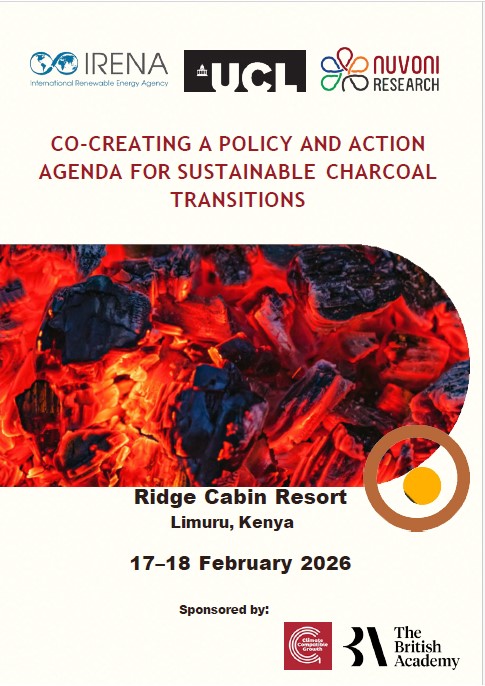
Organised by The International Renewable Energy Agency (IRENA), University College London (UCL), and Nuvoni Centre for Innovation Research, with financial support from the Climate Compatible Growth (CCG) Programme and the British Academy.
One billion people in sub-Saharan Africa still cook with charcoal and firewood as their primary fuel. The SDGs call for this practice to be eliminated by 2030, but progress remains slow despite major government and donor interventions promoting clean cooking. There are two main clean cooking strategies being deployed: 1) making the “available clean” by improving biomass combustion with higher-tech stoves, or 2) making the “clean available” by switching to alternative fuels like LPG, electricity, ethanol.
Policy efforts have tended to prioritise fuel switching, informed by evidence linking biomass use to deforestation, negative health outcomes, and time burdens. At the same time, a large body of evidence highlights the complexity of these relationships, pointing to context-specific environmental impacts, mixed health outcomes, and the importance of charcoal value chains for rural livelihoods. The mixed evidence calls for a reassessment of clean cooking strategies that reflects regional realities, acknowledging that biomass, particularly charcoal, is likely to remain a central part of African energy systems for some time.
The workshop will bring together policymakers, researchers, practitioners, and civil society actors to reflect on emerging evidence and policy narratives on charcoal and clean cooking in sub-Saharan Africa. The aim is to co-create a shared policy and action agenda for sustainable charcoal transition in Sub Saharan Africa.
Closed Event