Search
Close this search box

project details

Energy Transitions in Informal Settlements in Kenya

Research Area

Project Status

Ongoing

Start Date

2023

Project Overview

Reliable, affordable and sustainable energy systems play a crucial role in poverty alleviation and promoting wellbeing, as recognised in the Sustainable Development Goals (SDGs). However, access to such energy systems remains a significant challenge for informal settlements in the Global South, commonly known as ‘slums’, inhibiting their ability to overcome poverty and develop resilience to unforeseen shocks and vulnerabilities. Urban planning processes, including energy plans, often overlook the needs of these informal settlements as they are considered illegal or informal and unrecognised by governments. This exclusion underestimates the needs of the urban poor and risks further marginalisation as planning and development processes become increasingly data-driven, particularly for centrally managed resources such as electricity. This status quo inspired the design of the two related projects below, as follows:

Phase one

Energy-enabled resilience in urban informal settlements in Kenya: A Political Economy Analysis

Overview

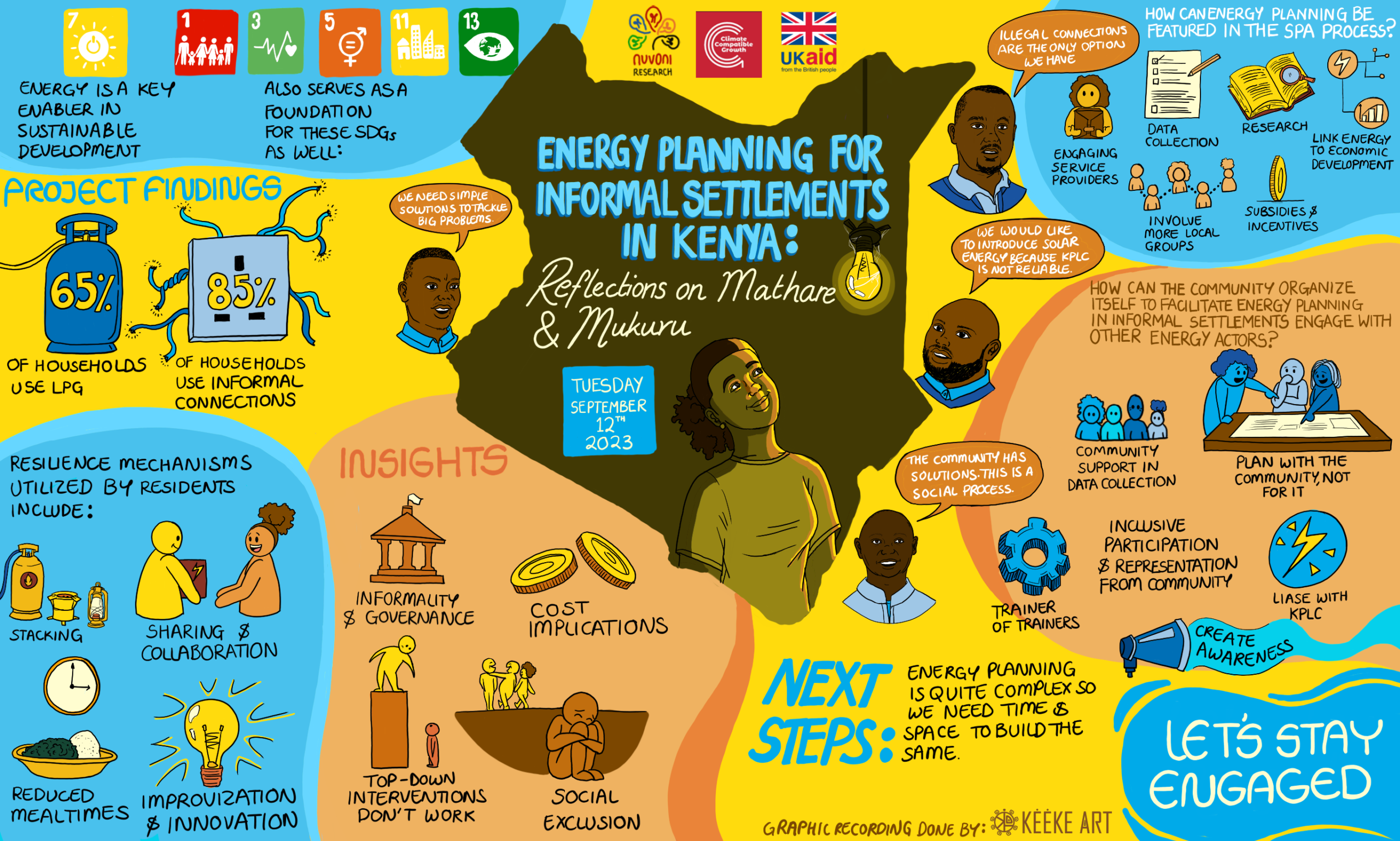
This project aimed to explore pathways for delivering inclusive, energy-enabled resilience in informal settlements. The study sought to understand current energy access in these settlements, as well as the patterns of energy use and related practices and their implications for resilience.  

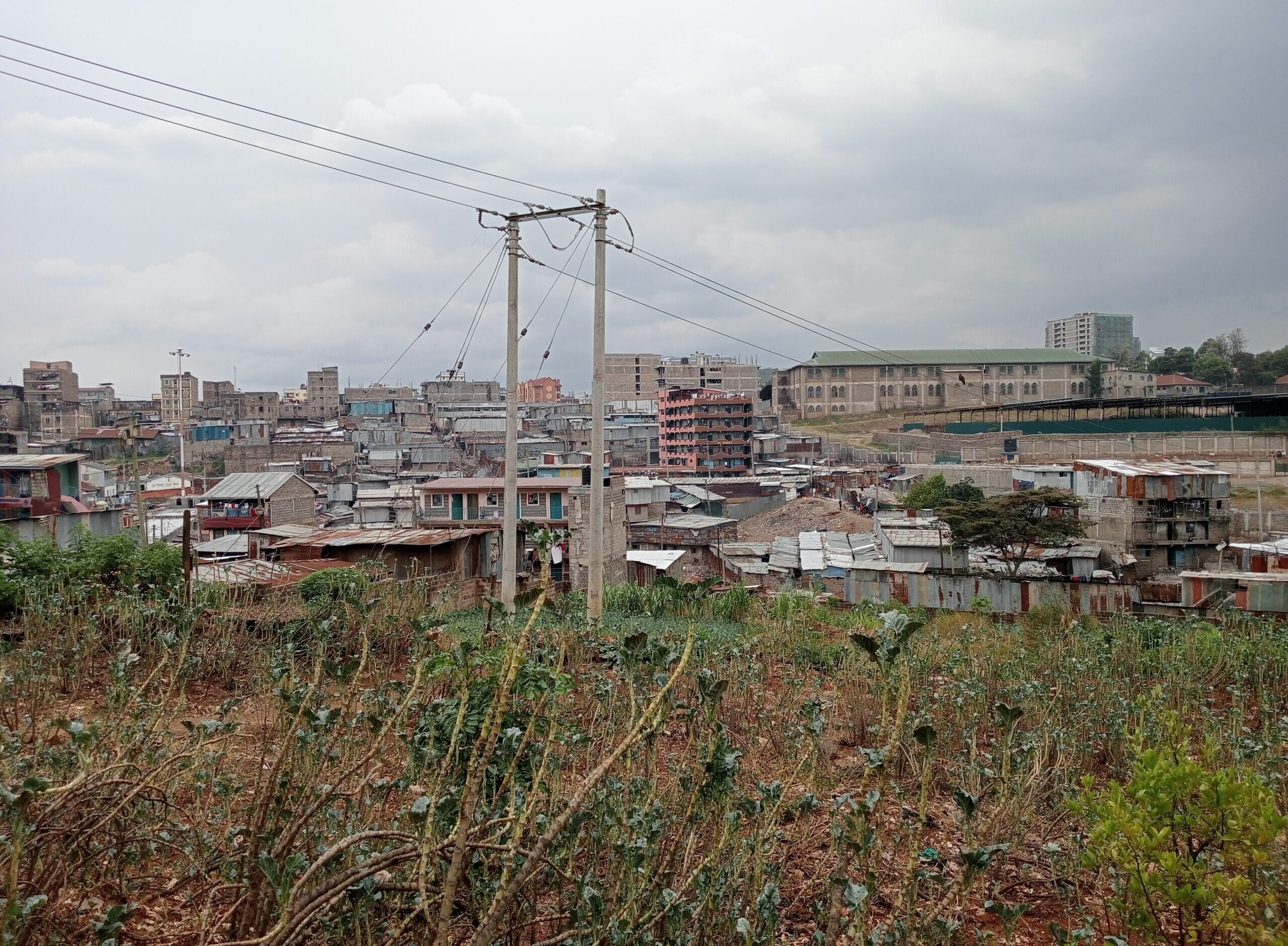
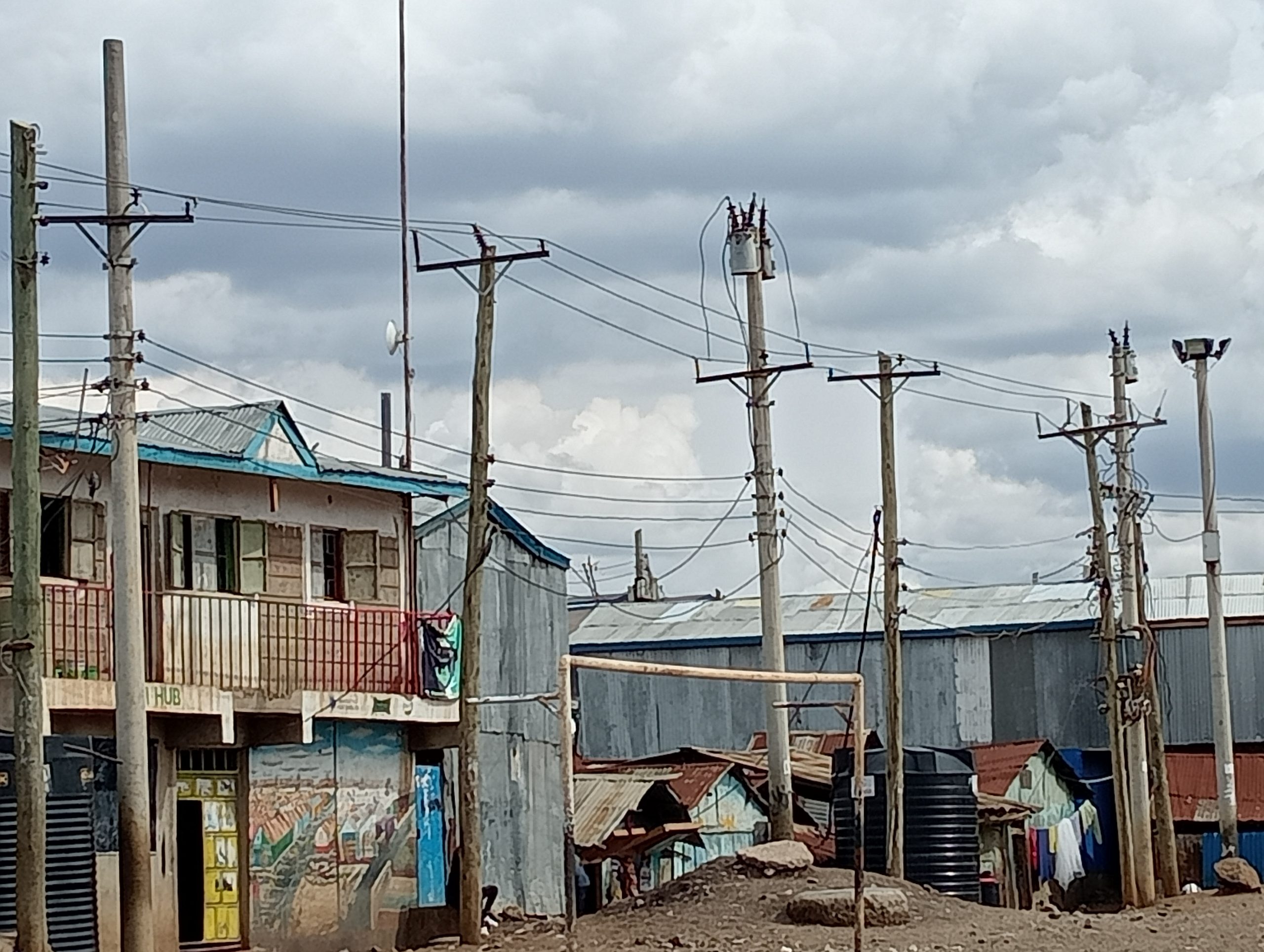
The study focused on two major settlements in Nairobi, Kenya: Mathare and Mukuru. Both settlements are characterised by hundreds of structures, densely packed and laid out without adhering to spatial layout guidelines. They have inadequate sanitation and water facilities, poor solid-waste management, few or no paved roads, and poor or unsafe access to the national electricity grid. The findings are intended to provide evidence to inform policy processes at both the national and county levels, particularly in energy planning. 

The analysis focused on understanding the existing situation by examining how energy in informal settlements was currently addressed in planning processes and the practices that either supported or limited energy resilience in these neighbourhoods.  

Research approach

Specifically, the project included: 


  • Analysis of governance and planning: The study looked at how energy access in two informal settlements had evolved over time. This included a scoping review of key documents. Additionally,  interviews were conducted with experts, including urban planners, energy industry professionals, representatives from national and local authorities, energy utilities, and residents of Mathare and Mukuru. This analysis provided insight into how the energy mix had developed over time and the role of policy and planning in shaping the current situation. 
  • Documentation of lived experiences: Focus group discussions were conducted with long-standing community members, leaders, elders, and community-based organisations to understand the governance and planning frameworks from the community’s perspective. The discussions addressed topics such as slum upgrading processes, ad hoc energy or electrification programmes, densification, and relocation, and how these dynamics had influenced energy transitions in the settlements.This community-based approach enriched the understanding of how energy transitions had impacted resilience, considering the economic, social, and cultural outcomes of these processes. 

The project’s findings provided a detailed analysis of the factors shaping energy resilience in informal settlements, offering valuable insights for future policy and planning efforts. 

Outputs

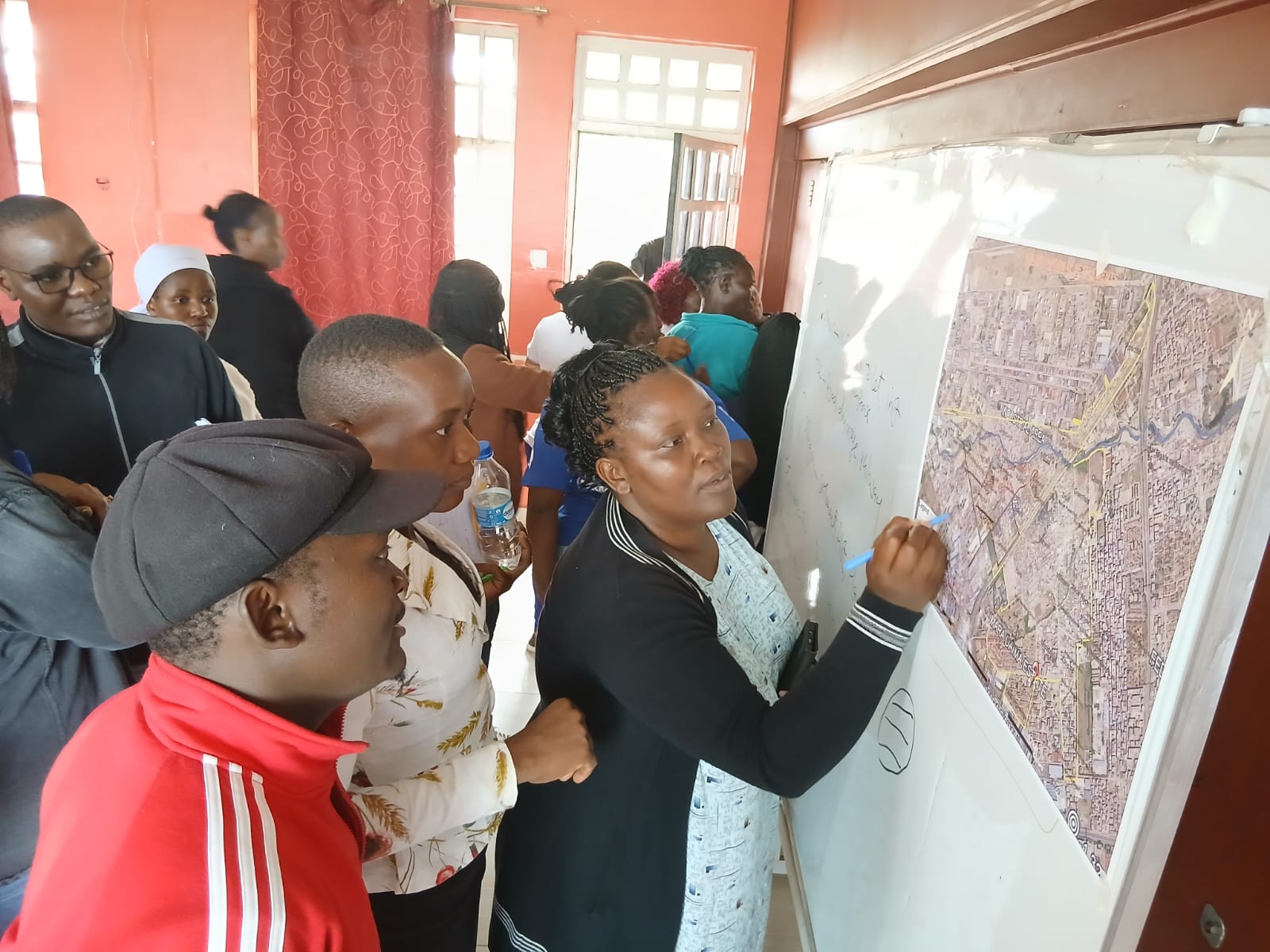
A stakeholder workshop was organised to:

The workshop was attended by a diverse range of stakeholders, including community leaders and residents of informal settlements, urban development experts, academic researchers focusing on energy access and urban resilience, representatives from the sector utility, policy makers, energy vendors and local service providers, industry professionals, NGOs, CBOs and organisations engaged in energy initiatives.

Read the workshop report here.

Phase two

From Margins to Mainstream: Integrating Informal Settlements into Kenya’s Energy System Models

Overview

This project builds upon the outcomes of the political economy analysis above. The aim of this project is to investigate how informal settlements could be considered in the development of energy planning, including in energy system models. In particular, the project goal is to develop an understanding of energy demand in informal settlements, which can also feed into energy modelling, based on the data available from previous projects led by Nuvoni Centre for Innovation Research. The implementation would be based on the case study of the Mathare settlement, used as a proxy for Nairobi’s informal settlements, and developed to in a way to ensure that it could eventually be integrated in energy system models, notably the county-to-national modelling framework under development for the second phase of the UKPACT project.

The study will:

This work has important implications for energy planning in informal settlements, particularly the need to make their energy needs and practices visible so that they are not only accounted for but also to provide appropriate support for local development and resilience. Thus, this effort will be carried out with the view of providing evidence for policy processes such as national and county-level energy planning.

Methodology

The project leverages the structural modelling approach, which captures causal pathways of energy demand. The model estimates and projections will then form the inputs in OSeMOSYS thus linking the household energy demand in the informal settlement to the national and / or county planning process.

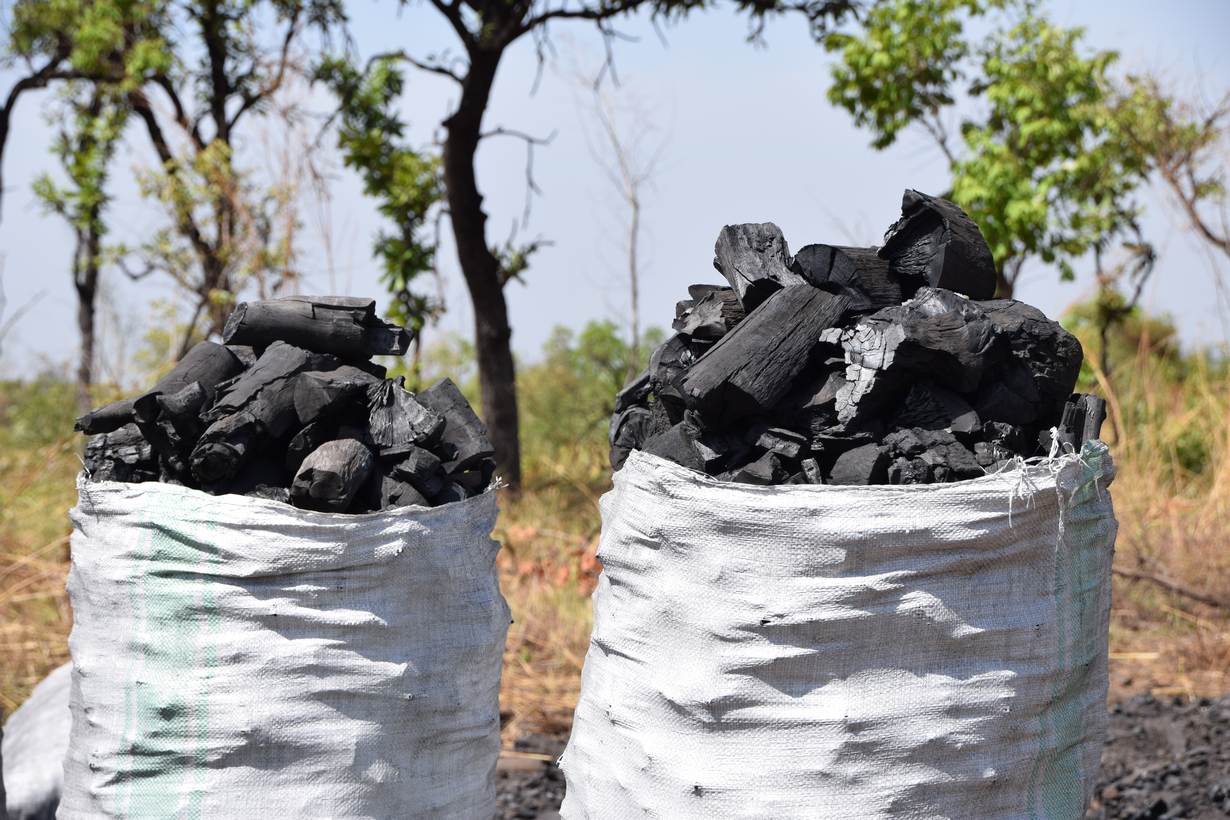
Our study is broadly scoped, covering the array of energy technologies and fuels spanning from biomass to modern energy services. Further, our study covers broader energy uses including for basic human needs such as lighting, cooking at the household level, for productive uses such as income-generating activities, and energy for education, health and other welfare-generating activities.

Expected Outcomes

The research outcomes will be as follows:

Phase three

Intersectional Analysis of Gender Equality and Social Inclusion (GESI) in Kenya’s Energy Sector: A focus on Informal Settlement.

Overview

Gender Equality and Social Inclusion are essential for ensuring equitable access to energy resources and services. Energy impacts people differently based on intersecting factors such as income, gender, ethnicity, disability, age, and geographic location. Women often face greater challenges due to their roles in households and communities, bearing disproportionate adverse effects from energy poverty. Persons with disabilities encounter systemic barriers to energy access, youth navigate precarious participation in informal energy economies, and informal settlement residents experience distinct energy vulnerabilities through illegal connections, frequent outages and safety risks. GESI frameworks help address these inequalities and promote fairness. However, effective integration requires understanding how socio-economic factors and existing social and institutional structures interact to determine individuals’ experiences with energy. 

Kenya has made significant progress in energy policy development, establishing frameworks such as the Energy Act (2019), Gender Policy in Energy (2019), and the Kenya National Cooking Transition Strategy (2023) to promote inclusive energy access. Despite these advances, marginalized groups remain systematically excluded. Current policies treat women, persons with disabilities, youth, and informal settlement residents as homogeneous categories, failing to recognize how multiple identities intersect to create compounded disadvantage. This research examined how intersecting vulnerabilities shape energy access experiences, with particular focus on informal settlements, which account for over 60% of Kenya’s urban population. 

The study focused on three critical areas: how current gender-neutral and single-identity policy frameworks mask complex patterns of exclusion; the distinct energy poverty conditions in urban informal settlements compared to rural areas; and the barriers preventing effective implementation of GESI commitments within energy sector institutions. An intersectional framework was applied to analyze energy access, moving beyond single-axis approaches to examine how power relations, social hierarchies and structural inequalities combine to produce differentiated energy outcomes. This approach situated energy policy within Kenya’s broader social, political, and institutional context, revealing how employment security, gender, age, disability and location interact to produce energy vulnerabilities that conventional approaches consistently fail to capture. 

The project contributes to advancing equitable energy transitions by providing evidence-based recommendations for operationalizing intersectional frameworks through disaggregated data systems, spatially targeted interventions, participatory governance models, and accountable institutional mechanisms. 
Methodologies

The tasks to be carried out under this project include:

Content analysis was used to elicit new insights on the existing governance structures and decision-making processes, institutional interests, values and norms in the power sector, incentive structures, political and economic conditions, and policy outcomes. 

Outcomes

The research outcomes will be:

Partners

UCL Institute for Sustainable Resources was the main partner in these two projects.

The project was funded by the Climate Compatible Growth (CCG) programme, an action-oriented research programme funded by the UK’s Foreign, Commonwealth and Development Office (FCDO) to support investment in sustainable energy and transport systems to meet development priorities in the Global South. CCG is aimed at generating robust and effective evidence, tools and frameworks on how countries in the Global South can best respond to the low-carbon transition, support growth aspirations and better meet the SDGs. 

These projects are bridging expertise and insights from WS5a’s projects on political economy and WS3’s projects on System Design.


Physical Address

No. MK088, Ushindi West Avenue,
Mukuyu Rd (Mukuyu West Wing), Thome 1
Nairobi, Kenya

Subscribe for newsletter & get news, events and publications updates

Email

Contact Us

Office Tel: (+254) 20 8009928 |
Mobile: (+254) 706 324 467

Work Inquiries

Interested in working with us?